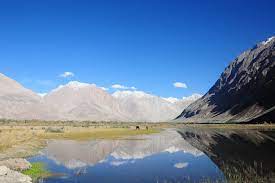
The sand beneath your feet is warm. That is the first thing that gets you, because everything here — the altitude, the thin air reaching you in shallow sips, the wind carrying ice off the Karakoram — should be cold. But Hunder's dunes hold the afternoon sun the way old stone holds warmth long after the fire has gone, and you stand there at 10,000 feet above sea level attempting to reconcile what your eyes are reporting with everything you thought you understood about the Himalayas. Behind you, two double-humped camels crop at brittle desert grass, their breath visible in the October air, their patience absolute. Ahead: the sharp white teeth of 22,000-foot peaks catching the last of the evening light in shades of amber and pale rose, their glaciers lit as if from within. No amount of research prepares you for this moment. No photograph, not even the finest ones, renders the scale with any accuracy. This is Nubra Valley — and it will quietly rearrange something at the back of your mind for years after you leave it.

To reach Nubra, you cross Khardung La. The pass sits at approximately 17,582 feet — the signboard has been revised downward by surveyors over the years, though the army convoy still calls it the world's highest motorable road, and at that altitude, pedantry feels beside the point. Oxygen arrives thin and unreliable; every movement above the snowline becomes deliberate, the jeep grinding through switchbacks while your body makes its quiet adjustments. The descent on the far side is vertiginous in a different way — not the road's severity but the sensation of falling off the edge of the known world, the valley floor appearing impossibly green and far below, the Shyok River a silver thread stitching it together. Until 1994, this valley was completely sealed to foreigners. It still requires an Inner Line Permit, and that bureaucratic requirement carries weight: you are approaching the Siachen Glacier, the world's longest non-polar glacier, and one of the most bitterly contested borders on the planet. Indian soldiers patrol terrain just north of where the poplar trees thin out. Nubra's Tibetan name — Ldumra — means the valley of flowers. The soldiers in the Siachen rarely see those.
The double-humped Bactrian camel is among the rarest large mammals alive. The wild population across Mongolia and northwestern China numbers fewer than a thousand animals — fewer than giant pandas. In Nubra Valley, a small domesticated herd has been here for centuries, descended from the animals that Silk Road traders left behind when the ancient routes across Central Asia collapsed and there was no longer any reason to move them. They are extraordinary creatures at close range: the thick winter coat arriving in dusty tufts, the two humps that mark them so sharply from the single-humped dromedaries of Rajasthan and the Gulf, the calm and faintly patrician expression of something that has survived ice ages and cares little for your astonishment. You can arrange a sunset ride across the Hunder dunes, and the experience has a quality even the most composed travellers struggle to articulate — the rocking gait, the creak of the wooden saddle frame, the sand spreading in both directions, and beyond it the valley's thin green strip of willow and poplar chasing the Shyok River westward, and beyond that the mountains, permanent and indifferent and beautiful in a way that makes you feel briefly, gratefully, very small.

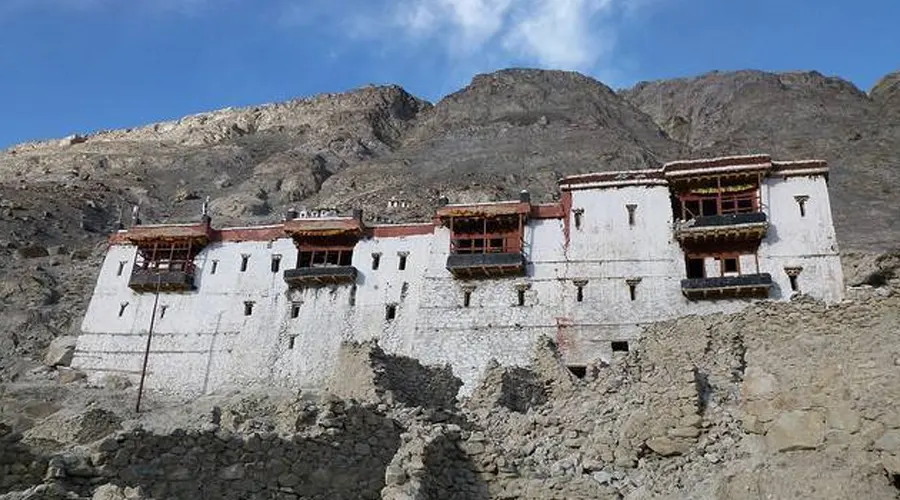
Diskit Gompa is the oldest and largest monastery in Nubra — 700 years old by the reckoning of its monks, founded in the 14th century by a disciple of Tsongkhapa, the philosopher who reformed Tibetan Buddhism into what became the Gelug school. It clings to a clifftop above the village with the implausible, slightly triumphant air of something that should not be there but has made itself comfortable over centuries. The climb up is steep enough to empty your lungs at this altitude; the reward is the valley laid out below you in its full implausible length, the dunes visible in the middle distance, the rivers converging. In 2010, the Dalai Lama consecrated a 32-metre Maitreya Buddha statue at the monastery's upper compound — the Future Buddha, seated in contemplation, facing north across the valley toward the Pakistani border and the glacier beyond it. The abbots say the orientation is deliberate: an offering of compassion toward a neighbour that has become a source of so much grief. Standing before it in the cold, with ravens circling on the thermals, the gesture does not feel merely symbolic. Inside the prayer hall, butter lamps throw their orange light across murals painted in the 15th century, and the monks' chanting drops so low it arrives not through the ears but through the sternum.
The Nubra night is something you do not entirely expect. Because the valley is enclosed — the Karakoram to the north, the Ladakh Range closing the south — no light from the rest of India reaches the valley floor after dark. Leh is 150 kilometres away across a pass that goes silent at dusk. When the camp generators at Hunder cut out around ten o'clock, and the fire in the courtyard drops to coals, the stars appear with a completeness that most people from cities have genuinely forgotten is possible: not a scatter of bright points but a continuous wash of light, the Milky Way dense enough to cast a faint shadow. In the cold, wrapped in borrowed wool and holding a cup of butter tea that tastes entirely wrong for the first week and then, suddenly, like nothing else will do, you find yourself thinking less about what you're seeing and more about who else moved through this valley — the Silk Road merchants with their Bactrian camels, the Tibetan pilgrims heading toward Tso Moriri, the soldiers somewhere on the glacier north of here, navigating by different stars toward different purposes. Nubra holds that weight without drama. It simply is what it has always been: a valley at the edge of the world that has made a quiet peace with its own extremity.